Anthropic IPO: Date, price range, valuation and how to buy ANT shares
Anthropic's IPO is on course to be one of the largest stock market entries on record, not long after the gargantuan listing of SpaceX. The listing will not be without controversy, with the potential for high volatility as people speculate on one of the companies at the centre of the AI revolution.
When is the Anthropic IPO, what might the company behind Claude be worth, and how could you buy shares once they list? Here is what is known so far.
When is the Anthropic IPO, what might the company behind Claude be worth, and how could you buy shares once they list? Here is what is known so far.
QUOTE
We tend to overestimate the effect of a technology in the short run and underestimate the effect in the long run.
Newly listed stocks may experience significant price volatility, and investors could lose part or all of their invested capital.
Big ideas
- Anthropic, the company behind Claude, confidentially submitted a draft S-1 for a US listing on 1 June 2026, made its S-1 public on 26 October 2026 and set a price range of $70 to $78 a share on 10 November 2026. It plans to price the IPO on 18 November and start trading on Nasdaq on 19 November 2026.
- Anthropic’s private valuation rose from $183bn in September 2025 to $965bn in May 2026, according to its Series F and Series H funding announcements. Its IPO price range, set out in its amended S-1, implies a valuation of up to about $1.4tn on a fully diluted basis.
- Annualised revenue reportedly passed $65bn by the end of July 2026, up from about $9bn at the end of 2025, and reached about $81bn by the end of October 2026 according to its amended S-1, although the company reported a large loss for 2025.
- Most retail investors can’t buy at the IPO offer price and instead buy once shares start trading on the open market. Trading 212 customers can place a pre-order ahead of the first day of trading: it stays pending and is filled at the market price once public trading begins, not at the IPO offer price, and doesn’t give you an IPO allocation. Funds are reserved when you place it, and you can cancel it at any time before it executes.
When is the Anthropic IPO date? Latest timeline and updates
Anthropic will price its IPO on Wednesday 18 November 2026, and its shares are expected to start trading on Nasdaq under the ticker ANT on Thursday 19 November 2026, the company announced on 12 November. Anthropic said in June 2026 that it had confidentially filed for a US listing, made its S-1 public on 26 October 2026 and launched its roadshow with a price range on 10 November 2026.
The public S-1 registration statement appeared on SEC EDGAR, the online database where such documents are filed, on 26 October 2026. An amended S-1 filed on 10 November 2026 added the price range and the number of shares on offer.
Before the public filing, there was a draft S-1 that was created to show select institutional investors in order to gauge the level of interest in an IPO. According to Bloomberg, Anthropic held an investor day at its San Francisco headquarters on 14 October 2026, where a small group of institutional investors could question its senior management ahead of the IPO.
Here is the timeline so far, based on SEC filings and reports:
- The public S-1 appeared on EDGAR on 26 October 2026
- The roadshow launched on 10 November 2026, with an amended S-1 setting a price range of $70 to $78 per share
- Pricing is scheduled for 18 November 2026
- Trading on Nasdaq is expected to start on 19 November 2026
What is known about its S-1
Before discussing what Anthropic has disclosed so far, it's worth considering: What is an S-1?
DEFINITION
An S-1 is the official document a company must file with the US Securities and Exchange Commission (SEC) before it can sell shares to the public for the first time via IPO. It works much like a legally required prospectus.
The UK equivalent is the prospectus approved by the FCA.
The UK equivalent is the prospectus approved by the FCA.
The S-1 explains in detail what the company does, how it makes (or intends to make) money and includes audited financial statements akin to those required to be published by public companies.
Management often likes to file an S-1 confidentially first so that the SEC can review the proposal without the company having to publish its finances, which only becomes a requirement when it goes public.
NOTE: Anthropic’s first public S-1, filed on 26 October 2026, did not include a share count or price range. The amended S-1 filed on 10 November 2026 sets out 825 million Class A shares at an estimated $70 to $78 each.
Expected IPO valuation and fundraising
The price range of $70 to $78 per share implies a valuation of up to about $1.4tn on a fully diluted basis, according to the amended S-1, below the $2tn most often cited in earlier reports.
The offering of 825 million shares would raise between $57.75bn and $64.35bn, which would make it one of the largest IPOs on record, second only to SpaceX’s listing in June 2026.
The underwriters named in the amended S-1 include Goldman Sachs and Morgan Stanley. JPMorgan Chase and Citigroup have also been reported as leading the capital raise.
To put the size of the offering into context, here is how Anthropic’s proposed IPO compares with the largest listings to date. Even at the bottom of its price range, it would raise more than twice as much as other big names such as SK Hynix, Saudi Aramco and Alibaba.
Largest IPOs by amount raised
# | Company | Year | Amount raised |
1 | SpaceX | 2026 | $75bn |
2 | Anthropic (proposed) | 2026 | $57.75bn–$64.35bn |
3 | SK Hynix | 2026 | $26.5bn |
4 | Saudi Aramco | 2019 | $25.6bn |
5 | Alibaba | 2014 | $21.8bn |
Amounts show the base offering and exclude over-allotment options. Anthropic’s figure is based on the price range in its amended S-1 and will change once the final offer price is set.
For the moment, Anthropic is still private, so there aren’t any publicly traded Anthropic shares available to buy today.
Trading 212 offers pre-orders on Anthropic (ANT) ahead of its first day of trading, and customers will be able to buy shares once trading opens on Nasdaq.
There is a way to get indirect exposure to the shares since Amazon (AMZN), Alphabet (GOOGL), Microsoft (MSFT) and Nvidia (NVDA) are all listed investors in Anthropic and should benefit from any increase in the valuation of their holdings. Of course, these are companies in their own right, so other factors can and will affect their share prices too.
WARNING
Be careful of pre-IPO offers to buy shares, funds and crypto tokens claiming Anthropic exposure ahead of listing. These are most likely fraudulent and should be avoided.
How does the Anthropic IPO allocation process work?
The general idea is that a company, in this case Anthropic, will decide (with the help of the investment banks it has hired) what they believe the valuation of the company is, what percentage of the ownership of the company it will sell, and from there, how many shares to issue, and at what price.
DEFINITION
IPO share allocation is how the underwriting banks decide how many shares each investor gets from those on offer.
Most shares in an IPO usually go to institutional investors, such as fund managers and pension funds, and most retail investors buy at the opening market price, not the offer price (see Trading 212’s SpaceX IPO guide).
Anthropic expects up to 20% of the offering to be allocated to retail investors, according to reports on its amended S-1. The rest, at least 80%, is expected to go to institutional investors.
As a point of reference, SpaceX’s IPO had a reported 70:30 institutional to retail split, with only about 5% of the company’s shares sold in the IPO. That’s an unusually high allocation to retail investors.
Company insiders and early investors are usually subject to a “lock-up period”, which means they can’t sell their shares for a set time after the IPO, typically 90 to 180 days.
What will Anthropic’s stock ticker symbol be?
According to its S-1, Anthropic has applied to list its shares on Nasdaq under the ticker ANT.
The shares on offer are Anthropic’s Class A common stock, the ordinary shares available to the public, which carry one vote each. They will trade on the Nasdaq Global Select Market, the top tier of the Nasdaq stock exchange in the US.
ANTP has appeared as a placeholder on some investment websites, but it isn’t Anthropic’s ticker. The official ticker is ANT.
DEFINITION
A stock ticker is a 2-4 letter symbol representing the shares of a company. For example, Microsoft (MSFT) or Barclays (BARC).
Is Anthropic profitable? Revenue and losses from its S-1
No. According to its S-1, Anthropic is not profitable. Its amended S-1 shows revenue of $33.2bn for the first nine months of 2026, including $17.0bn in the third quarter, and a net loss of $104.0bn over the same period.
Most of that loss doesn’t come from running the business. About $94.3bn of it is an accounting charge for the rising value of convertible notes and similar financing instruments, which grew as Anthropic’s valuation increased. It’s a non-cash charge, meaning no money left the company. Looking at operations alone, Anthropic made an operating loss of about $1.3bn in the first nine months of 2026. That includes operating income of about $1.0bn in the second quarter and an operating loss of about $536m in the third quarter.
The S-1 also confirms Anthropic’s full-year figures for 2025: revenue of about $4.6bn, an operating loss of about $8.1bn and a net loss of about $42.0bn, of which $34.3bn was the same type of non-cash charge. Its biggest cost is computing power and infrastructure, which came to about $7.3bn in 2025 and $18.8bn in the first nine months of 2026.
How does Anthropic make money? Claude subscriptions, enterprise contracts, and API usage
Although there are likely bigger plans down the road, Anthropic makes money via its chatbot, Claude.
Claude subscriptions for individuals currently split into three categories (Free, Pro, Max) plus Team and Enterprise plans.
Claude API is used by developers and businesses, which pay per token used instead of a subscription because of the large amount of computing power used up on an enterprise level and for large projects.
- Cloud marketplaces: Claude is sold through Amazon Bedrock, Google Cloud and Microsoft.
- Claude Code: reported run rate of about $1bn within roughly six months of launch (2025).
- Business customers made up about 80% of revenue in late 2025 (Reuters); more than 1,900 customers paying over $1m a year as of 30 September 2026, according to its S-1.
Anthropic’s revenue model: usage-based pricing vs subscriptions
For everyday use cases, a Claude subscription is going to be enough to give most people what they want and a typical subscriber costs Anthropic well under what they pay. At some high levels of usage, a subscription might be seen as a "loss-leader", but it’s likely subscription prices will rise over time alongside adoption to cover such instances.
The big money is made via the API customers who get billed per million tokens, but this revenue stream is less stable since it will rise and fall with usage, which might get cut when companies are cost-cutting or folding specific development projects.
From an investor’s perspective, subscriptions provide more predictable revenue via fixed fees, while pay-per-use is more profitable but more variable and subject to how compute costs affect margins.
How much money could Anthropic raise through its IPO?
According to the amended S-1, the sale of 825 million shares at $70 to $78 each would raise between $57.75bn and $64.35bn, and Anthropic has separately agreed to sell $26bn of non-voting Class N stock to strategic partners at the IPO price. Class N shares are a separate class of non-voting stock that Anthropic is selling privately to seven strategic partners (AMD, Broadcom, Google, Micron, Microsoft, Nvidia and TSMC) at the IPO price. They are not part of the public offering on Nasdaq and give no voting rights. Earlier reports had put the target at more than $100bn (New York Times, August 2026). For some context, Saudi Aramco’s IPO in 2019 raised $25.6bn, or $29.4bn including over-allotment.
According to its S-1, Anthropic plans to use the money it raises for general corporate purposes, including computing power and infrastructure, working capital and operating costs. Anthropic won’t receive any of the money from shares sold by existing shareholders.
According to its S-1, Anthropic plans to use the money it raises for general corporate purposes, including computing power and infrastructure, working capital and operating costs. Anthropic won’t receive any of the money from shares sold by existing shareholders.
How is Anthropic’s IPO valuation calculated?
First principles say that market value = share price x total shares outstanding.
The bankers working on the deal will put in the long hours to weigh comparable companies, revenue multiples, growth and demand from the bookbuild. Bookbuild is the process in which underwriting banks gather orders from institutional investors during the roadshow, showing how many shares they want and at what price, and use that demand to set the final IPO price. Roadshow is the marketing period before an IPO is priced, usually one to two weeks long. The company’s management and its underwriting banks present the business to institutional investors through meetings and presentations, while the banks collect orders for the bookbuild.
A company’s valuation can be quoted in two ways when it raises money. The pre-money valuation is what the business is judged to be worth before the new cash arrives. The post-money valuation is that figure plus the new investment.
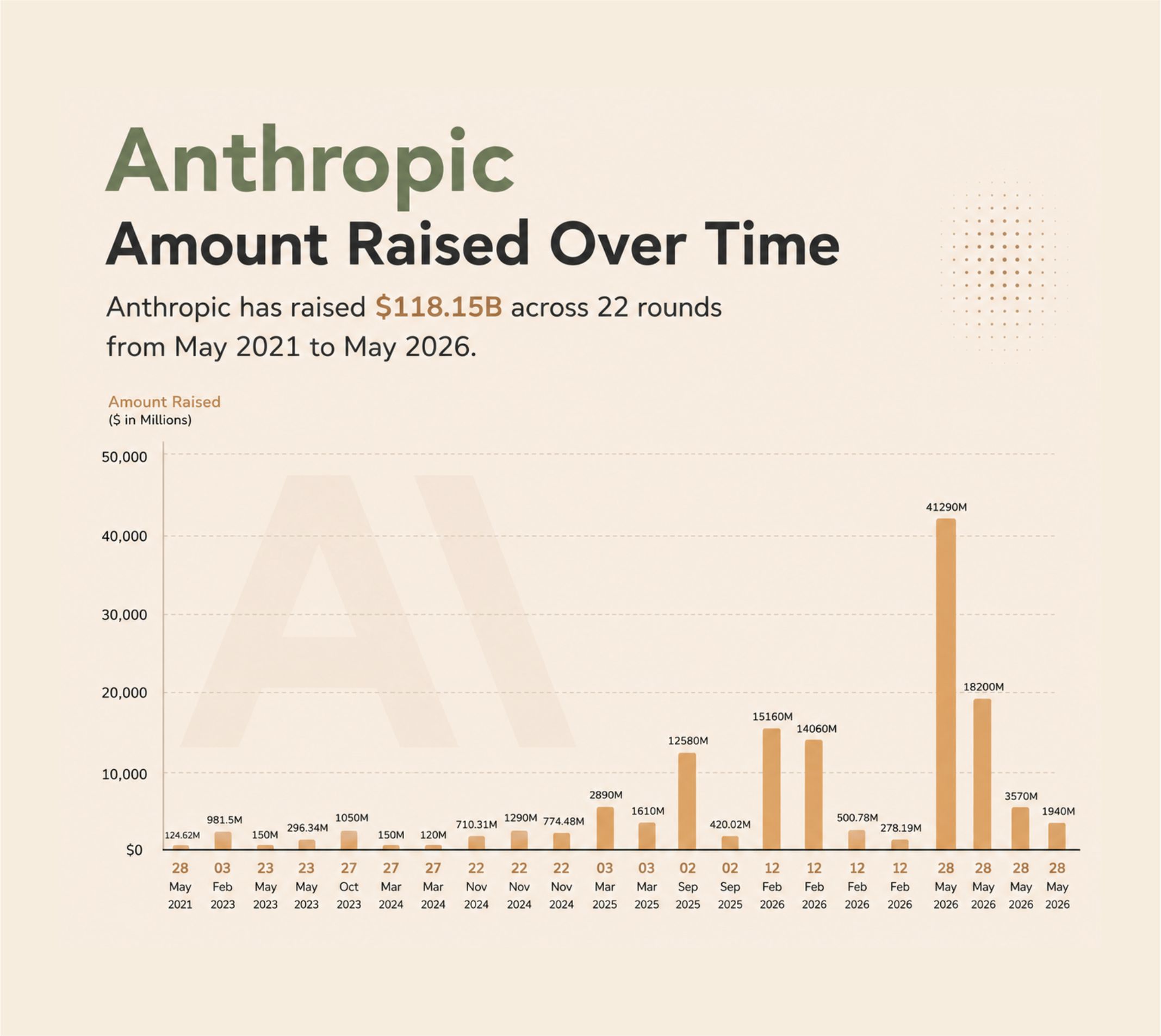
Anthropic’s multiple private funding rounds show how this works.
Anthropic valuation history, from $623 million to $965 billion
 Source: GraniteShares
Another common way to judge a valuation is to compare it with revenue. If Anthropic listed at the top of its price range, around $1.4tn on a fully diluted basis, dividing that by its $81bn annualised revenue run rate (end of October 2026) gives a multiple of roughly 17 times revenue.
Valuation comparison between Anthropic and other tech giants
Company | Market cap | Price/sales | Price/earnings |
Apple | ~$5.2tn | ~11x | ~40x |
Nvidia | ~$4.2tn | ~14x | ~22x |
Alphabet | ~$3.6tn | ~8x | ~15x |
Amazon | ~$2.9tn | ~3.7x | ~21x |
Anthropic | ~$1.4tn * | ~17x (on its $81bn run rate) | n/a (not profitable on a statutory basis) |
* Implied at the top of the IPO price range on a fully diluted basis. This is not an actual market capitalisation, and the final offer price may differ.
Figures for Apple, Nvidia, Alphabet and Amazon are approximate, based on market data as of 11 November 2026, and will change with share prices. Table for illustrative purposes, not indicative of future performance.
Figures for Apple, Nvidia, Alphabet and Amazon are approximate, based on market data as of 11 November 2026, and will change with share prices. Table for illustrative purposes, not indicative of future performance.
Anthropic’s revenue growth, losses, and financial performance
The following tables summarise Anthropic’s growth, using its S-1 filings, company announcements and press reports.
Run-rate growth (estimated annualised revenue at each date)
Date | Annualised run rate |
Aug 2025 | $5bn+ |
Oct 2025 | ~$7bn |
Dec 2025 | ~$9bn |
End Q1 2026 | $30bn+ |
End Jul 2026 | $65bn+ |
End Sep 2026 | ~$71bn |
End Oct 2026 | ~$81bn (amended S-1) |
End 2026 (analyst estimate) | ~$110bn |
Reported revenue and losses
Period | Revenue | Profit / loss |
2024 | $386m | Operating loss ~$3.0bn; net loss ~$8.3bn (S-1) |
2025 | ~$4.6bn | Operating loss ~$8.1bn; net loss ~$42.0bn, of which ~$34.3bn non-cash (S-1) |
Q1 2026 | $4.7bn | Operating loss ~$1.7bn (S-1) |
Q2 2026 | $11.6bn | Operating income ~$1.0bn (S-1) |
Q3 2026 | $17.0bn | Operating loss ~$536m (amended S-1) |
9M 2026 | ~$33.2bn | Operating loss ~$1.3bn; net loss ~$104.0bn, of which ~$94.3bn non-cash (amended S-1) |
Note: Run rate is Anthropic’s estimate of annualised revenue at a point in time, so in a fast-growing business it runs ahead of revenue actually booked (e.g. $30bn+ run rate at end Q1 2026 vs $4.7bn booked in the quarter). Most of the net loss comes from non-cash changes in the fair value of convertible notes and similar instruments, not from day-to-day operations. Figures marked “reported” come from press reports; $110bn is an analyst estimate. When investing, your capital is at risk. Past performance is no guarantee of future results.
Anthropic’s IPO valuation explained: revenue multiples and risk factors
At the top of its price range, Anthropic would be valued at about $1.4 trillion on a fully diluted basis. That is about 17 times its $81bn annualised revenue run rate at the end of October 2026. When Anthropic was valued at $965bn in May 2026, its run rate was about $47bn, which works out at about 21 times.
A revenue multiple compares a company’s valuation with its sales. Growth companies often trade on high multiples because investors are pricing in future growth, which may or may not happen.
The run rate is Anthropic’s estimate of its annualised revenue at a point in time, based on recent usage and subscriptions. In a fast-growing company, it can be much higher than the revenue actually booked over the past year. For example, Anthropic’s revenue for the first nine months of 2026 was $33.2bn.
Anthropic’s S-1 sets out the risks it sees for its business in the “Risk Factors” section, including its losses, its spending on computing power and competition. You can read the full list in the S-1 on SEC EDGAR.
Does Anthropic depend on Amazon, Google, and Microsoft and how much if so?
Although large companies often depend on each other, particularly in Silicon Valley, Anthropic’s reliance on a small number of partners for computing power, distribution and investment is a risk to keep in mind. Its S-1 sets out the risks it sees in the “Risk Factors” section.
- Amazon: invested $8bn (2023 to 2024); AWS is Anthropic's primary cloud and training partner; Claude sold via Bedrock.
- Google: holds about 14% (reported 2025); supplies TPU chips; added more under an existing commitment in May 2026.
- Microsoft and Nvidia: combined investment of up to $15bn (November 2025); Anthropic committed to buy $30bn of Azure computing capacity, up to 1 gigawatt.
How does Anthropic’s latest private valuation compare with its IPO target?
The top of the IPO price range implies a valuation of about $1.4 trillion, roughly 45% above the May 2026 valuation of $965bn.
But arguably $1.4 trillion would be in keeping with the private capital raises running up to it. Notably the Series H was led by Altimeter, Dragoneer, Greenoaks and Sequoia and valued Anthropic above OpenAI for the first time.
Valuation history:
But arguably $1.4 trillion would be in keeping with the private capital raises running up to it. Notably the Series H was led by Altimeter, Dragoneer, Greenoaks and Sequoia and valued Anthropic above OpenAI for the first time.
Valuation history:
- Series F, Sept 2025: $13bn raised at a $183bn post-money valuation
- Series G, Feb 2026: $30bn raised at a $380bn post-money valuation
- Series H, 28 May 2026: $65bn raised at a $965bn post-money valuation
Anthropic set a price range of $70 to $78 per share in an amended S-1 filed on 10 November 2026, at the start of its roadshow. The final offer price will be set after the roadshow.
As an individual investor, it’s important to understand the difference between the offer price and the opening price. The offer price is what institutional investors pay in the IPO. Once trading starts, the price is set by supply and demand in the market, and it can be very different from the offer price, either higher or lower.
Newly listed shares can be highly volatile, especially in the first days and weeks of trading. Prices can swing sharply, sometimes within minutes, and there may be large gaps between one trade and the next. If you place a pre-order, it’s filled at the market price once trading begins, which may be far from the offer price or the price range.
SpaceX is a recent example: it priced at $135, closed its first day at $161 (+19%), then later traded back below its IPO price.
How to buy Anthropic on Trading 212
You can find Anthropic (ANT) on Trading 212 and place a pre-order ahead of its first day of trading on Nasdaq.
- Step 1: Log in to the Trading 212 app or web platform, or open an account if you don’t have one. Make sure your account is verified and funded before the listing date.
- Step 3: Now that the price range has been published, you can place a pre-order. You’ll need to read and accept the risks of pre-listing orders before your first one. With Invest and Stocks ISA accounts, you can choose a market value order (you choose how much to invest, and it’s filled at the market price once trading begins) or a limit order (you set the maximum price you’re willing to pay per share and it only fills if the market price reaches your limit). Your pre-order stays pending until Anthropic starts trading, and the funds are reserved in your account. It’s filled at the market price at that time, which may be higher or lower than the IPO offer price. You can cancel it at any time before it executes.
- Step 4: Trading 212 supports fractional shares, so you don’t need to buy whole shares. Choose how much you want to invest, and the number of shares is calculated for you.
- Step 5: Newly listed shares can be very volatile, so it’s worth monitoring your order and position in the first days of trading. Once Anthropic is trading, you can also buy or sell its shares like any other stock.
Anthropic IPO vs OpenAI IPO
OpenAI hasn’t gone public yet. It reportedly filed confidentially for a US listing in June 2026, and its CFO, Sarah Friar, reportedly said in August that it would be a public company in 2027.
Anthropic’s May 2026 funding round valued it above OpenAI for the first time. OpenAI was reportedly valued at $1.25tn in November 2026 after raising a further $11bn, compared with up to about $1.4tn implied by the top of Anthropic’s IPO price range. Both companies are public benefit corporations, meaning they’re legally required to balance profit with a stated public mission.
On revenue, OpenAI’s annualised run rate was reportedly about $50bn at the end of September 2026, compared with about $71bn for Anthropic at the same point. The two companies count revenue differently, though: Anthropic records sales made through cloud partners in full (gross), while OpenAI records only its share (net), so the figures aren’t directly comparable.
Anthropic IPO vs SpaceX IPO
SpaceX listed on Nasdaq under the ticker SPCX on 12 June 2026 at $135 a share, valuing it at about $1.77tn. It raised about $75bn before the underwriters’ additional shares. Its shares closed the first day at $161, up 19%, but by late July they had reportedly fallen back below the IPO price.
At up to about $1.4tn, Anthropic’s implied valuation is smaller than SpaceX’s at listing. On revenue, Anthropic booked $11.6bn in the second quarter of 2026, compared with SpaceX’s reported $7.8bn over the same period.
SpaceX’s experience shows that a large, high-profile IPO doesn’t guarantee gains once shares start trading. Past performance doesn’t guarantee future results.
Anthropic vs Google and Microsoft
Anthropic is both a partner and a competitor to Google and Microsoft. Google develops its own AI models (Gemini) and is also an investor in Anthropic, while Microsoft’s Copilot uses models from both OpenAI and Anthropic.
The businesses are very different. Alphabet and Microsoft are profitable, with revenue from many sources, including search, YouTube, cloud computing and software. Anthropic’s revenue comes almost entirely from AI, and it isn’t yet profitable on a statutory basis (under standard accounting rules).
As of 11 November 2026, Alphabet was worth about $3.6tn and Microsoft about $3.9tn, roughly two and a half to three times the valuation implied by the top of Anthropic’s IPO price range.
Recap
Anthropic, the developer of the Claude AI models, confidentially submitted a draft S-1 in June 2026, made it public on 26 October 2026 and set a price range of $70 to $78 per share on 10 November 2026, and plans to start trading on Nasdaq on 19 November 2026. Its private valuation rose from $183bn in September 2025 to $965bn in May 2026, and its IPO price range implies a valuation of up to about $1.4tn.
Annualised revenue grew from about $9bn at the end of 2025 to about $81bn by the end of October 2026, although the company remained loss-making. Retail investors typically buy newly listed shares at the opening market price rather than the offer price, and prices can swing sharply in early trading.
Annualised revenue grew from about $9bn at the end of 2025 to about $81bn by the end of October 2026, although the company remained loss-making. Retail investors typically buy newly listed shares at the opening market price rather than the offer price, and prices can swing sharply in early trading.
FAQ
Q: Is Anthropic on Trading 212?
Yes. Anthropic (ANT) is already on Trading 212, and you can place a pre-order ahead of its first day of trading. You won’t be able to trade the shares until they start trading on Nasdaq.
Q: Can I buy Anthropic IPO on Trading 212?
You can’t buy Anthropic shares at the IPO offer price on Trading 212, but you can place a pre-order for Anthropic (ANT) ahead of its first day of trading. Your pre-order is filled at the market price once trading begins on Nasdaq, which may be higher or lower than the IPO offer price.
Q: How to buy an Anthropic IPO?
Once Anthropic starts trading, you can buy its shares through a broker using the ticker ANT. On Trading 212, search for ANT in the app. You can also place a pre-order before trading begins.
Q: When will Anthropic start trading?
Anthropic’s shares are expected to start trading on Nasdaq under the ticker ANT on Thursday 19 November 2026, after the IPO is priced on 18 November.
Q: What is the Anthropic IPO price?
Anthropic has set a price range of $70 to $78 per share in its amended S-1. The final offer price will be set after the roadshow, and the price you pay once trading starts depends on the market.
Q: Is there a minimum investment required to buy Anthropic shares?
Anthropic doesn’t set a minimum for buying its shares on the market. Any minimum depends on your broker. On Trading 212, fractional shares let you invest a smaller amount.
Q: Will Anthropic list on Nasdaq or the New York Stock Exchange?
Nasdaq. According to its S-1, Anthropic has applied to list its Class A common stock on the Nasdaq Global Select Market under the ticker ANT.